

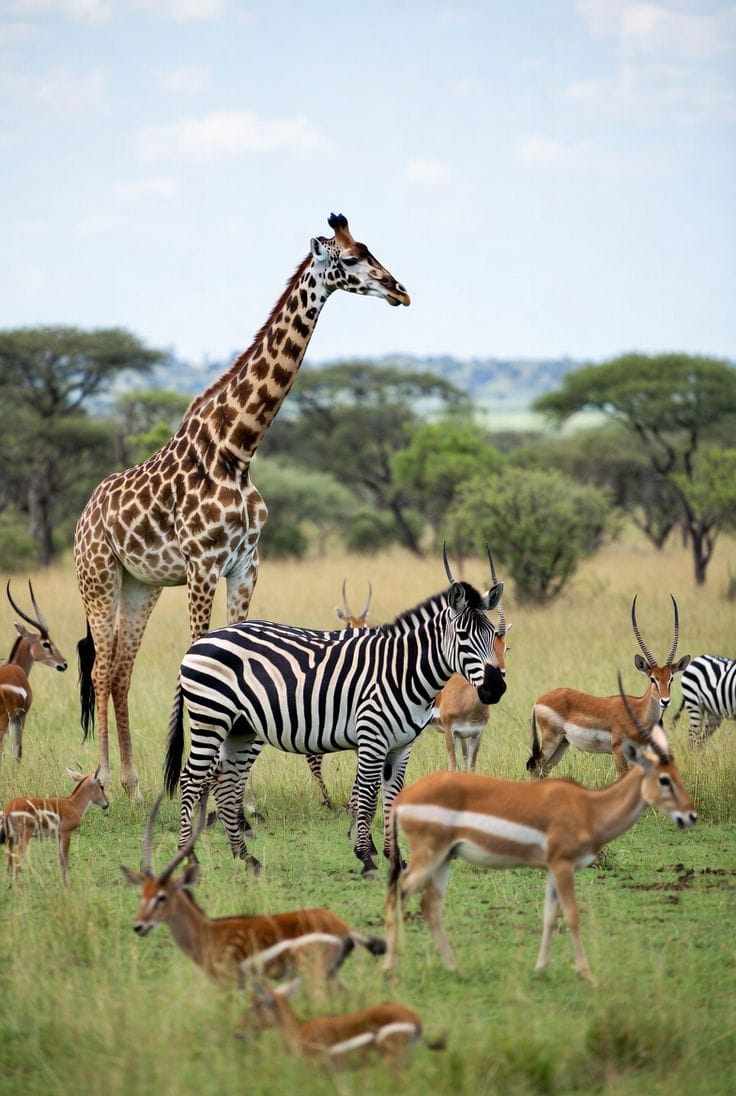
Imagine standing in the middle of the African savannah. A herd of zebras grazes peacefully in the grass. Nearby, elephants move slowly across the plains, while giraffes feed on tall trees. Above them, eagles soar through the sky.
However, the wilderness is never as quiet or peaceful as it appears. Somewhere in the grass, a lion may be watching its next meal. A cheetah may be preparing for a chase, while vultures circle above, searching for food.
This is the circle of life in the African wilderness. Every animal, plant and living organism has a role to play. From the smallest insects to the largest elephants, nature works through a connected system that keeps the ecosystem alive.
But how does this natural balance work?
1. It All Begins With Plants
Plants are the foundation of life in the African wilderness. They provide food and shelter for many animals.
Across the savannah, grasses feed zebras, wildebeest, buffaloes and antelopes. Meanwhile, giraffes browse on leaves from tall trees, while elephants feed on grass, bark, roots and branches.
Plants also support smaller creatures, including insects and birds.
Without vegetation, many herbivores would struggle to survive. In turn, predators would lose an important source of food.
This is why healthy grasslands, forests and wetlands are essential for wildlife.
2. Herbivores: The Plant Eaters of the Wild
Herbivores are animals that mainly feed on plants. They form an important link between vegetation and predators.
Some of the most familiar herbivores in Africa include:
- Zebras
- Wildebeest
- Elephants
- Giraffes
- Buffaloes
- Gazelles
- Antelopes
These animals help shape their surroundings. For example, grazing animals feed on grass, while elephants can break branches and push over trees.
Their feeding habits influence how vegetation grows and changes over time.
However, herbivores must also remain alert. The African wilderness is home to predators that depend on them for survival.
3. Predators: Keeping Wildlife Populations in Balance
Predators are an important part of the natural food chain. They hunt other animals to survive and help influence the size and distribution of prey populations.
Africa has some of the world’s most remarkable hunters.
Lions often hunt in groups, using teamwork to catch animals such as zebras and wildebeest.
Leopards depend on patience and stealth. They usually hunt alone and are excellent climbers.
Cheetahs use incredible speed to catch smaller antelopes and other prey.
Hyenas are both hunters and scavengers. They can hunt in groups and also feed on animals killed by other predators.
Crocodiles wait beneath the water for animals that come to drink.
Each predator has its own hunting strategy. Together, they form an important part of the African ecosystem.
4. Scavengers: Nature’s Clean-Up Team
Not every animal needs to hunt to find food.
Scavengers feed on animals that have already died. They help remove carcasses from the environment and make use of food that would otherwise remain unused.
Vultures are among Africa’s best-known scavengers. With excellent eyesight, they can spot carcasses from high above the ground.
Hyenas also play this role, although they are skilled hunters too.
Other scavengers, including jackals and certain insects, help break down animal remains.
This process returns nutrients to the environment and supports other forms of life.
5. Decomposers: Returning Nutrients to the Soil
The circle of life does not end when an animal dies.
Fungi, bacteria and other tiny organisms break down dead plants and animals. This process is called decomposition.
As these remains break down, nutrients return to the soil. Plants then absorb these nutrients as they grow.
In this way, the natural cycle continues.
Without decomposers, dead organic material would accumulate, and important nutrients would not return to the soil as efficiently.
6. Water: The Lifeline of the Wilderness
Water is essential to every part of the African ecosystem.
Rivers, lakes, wetlands and waterholes support wildlife throughout the year. During dry seasons, these places become especially important.
Herbivores travel long distances in search of water and fresh grazing areas. Predators often follow them because they know where prey is likely to gather.
Birds depend on wetlands for food and breeding grounds. Crocodiles use rivers and lakes as hunting habitats, while elephants may visit water sources to drink and cool themselves.
This explains why protecting rivers, lakes and wetlands is just as important as protecting the animals themselves.
7. Birds Have an Important Role Too
Birds are sometimes overlooked when discussing the circle of life. However, they contribute to the health of the African wilderness in several ways.
Eagles hunt smaller animals, while secretary birds feed on snakes, insects and other small creatures.
Vultures remove animal carcasses, helping keep the environment clean.
Other birds feed on insects, spread seeds and pollinate certain plants.
From the powerful African fish eagle to the colourful bee-eaters, birds are an important part of the ecosystem.
8. What Happens When the Natural Balance Is Disturbed?
The African wilderness depends on a healthy balance between plants, animals and the environment.
When one part of the ecosystem is affected, other parts can also suffer.
For example, habitat destruction reduces the space available for wildlife. This can affect feeding, breeding and migration.
Poaching can reduce animal populations and disrupt natural relationships between predators and prey.
Climate change and prolonged droughts can also reduce water and food supplies.
These challenges show why wildlife conservation is so important. Protecting one species often means protecting many others that depend on the same habitat.
Where Can You Experience the Circle of Life in Kenya?
Kenya offers some of the best places to witness nature’s connections in action.
Maasai Mara National Reserve: Famous for its predators, large herbivore populations and the annual wildebeest migration.
Amboseli National Park: Known for its large elephant herds, open plains and beautiful views of Mount Kilimanjaro.
Lake Nakuru National Park: A wonderful destination for birdwatching and spotting wildlife, including black and white rhinos.
Samburu National Reserve: Home to unique northern Kenyan wildlife, including Grevy’s zebra, gerenuk and reticulated giraffe.
Tsavo National Parks: Famous for their vast landscapes, elephants, lions and diverse wildlife.
Each destination offers a different opportunity to understand how nature works.
Experience the Circle of Life With Dawnlight Safaris
A safari is more than an opportunity to see wild animals. It is a chance to understand how nature connects every living thing.
Watching a lion hunt, seeing elephants move across the plains or spotting vultures circling above the savannah gives you a deeper appreciation of the wilderness.
With Dawnlight Safaris, explore Kenya’s remarkable wildlife destinations and discover the beauty of nature through unforgettable safari experiences.
Every animal has a role. Every habitat matters. And every safari tells a story about the circle of life.
